What is Answer Engine Optimisation (AEO) and why does it matter for Irish small businesses in 2026?
Updated for 2026 · 10-minute read
nswer Engine Optimisation (AEO) is the practice of building your business content so that AI tools like ChatGPT, Perplexity, Google AI Overviews and Gemini can pick it up and quote it directly when someone asks a question. It is not the same as SEO. SEO gets you ranked. AEO gets you cited. For Irish small businesses in 2026, that distinction is the difference between being found and being invisible. That matters more here than almost anywhere else. According to Google’s March 2026 research with Amárach, 80% of Irish SMEs believe AI can help their business, but only a fraction are doing anything about it. The businesses that act now will own the AI answer space in their industry. The ones that wait will spend the next two years trying to catch up. This guide explains what AEO actually is, how it differs from SEO, why Irish small businesses are uniquely placed to benefit, and what you can do this month without spending a euro.
What does AEO actually mean?
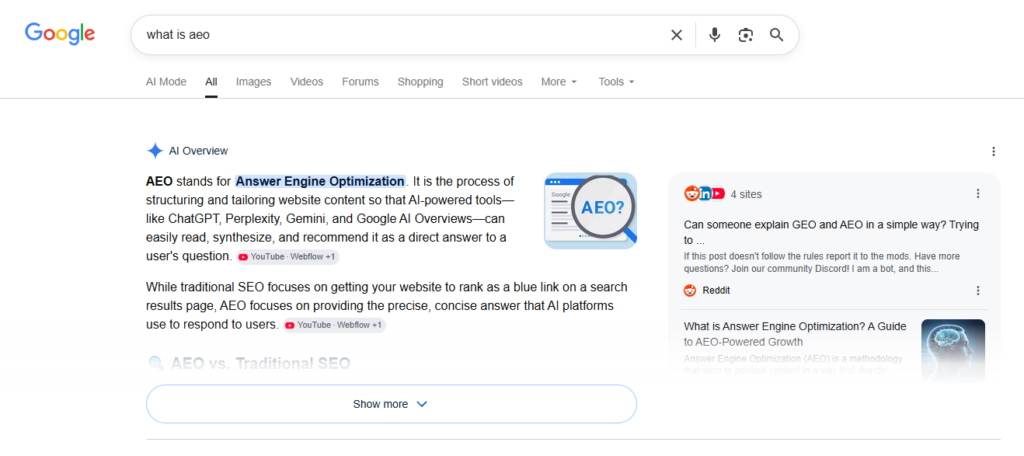
AEO is short for Answer Engine Optimisation. The “answer engines” are the AI tools that now sit on top of search: ChatGPT, Perplexity, Google’s AI Overviews, Microsoft Copilot, Gemini. When somebody asks one of these a question, the AI doesn’t just point them at a list of websites. It reads through dozens of sources in the background and gives back a single, written answer.
If your business is mentioned in that answer, you win. If it isn’t, you don’t exist as far as the customer is concerned.
AEO is the work of making sure your content is easy for those AI tools to read, trust, and quote. That means writing in clear questions and answers, anchoring everything in real evidence, using structured data so AI can parse your pages without guessing, and being specific enough that an AI can tell you apart from the next business doing roughly the same thing.
The good news for small businesses is that AEO is not a money game. It is a clarity game. A well-written FAQ page from a small Dublin clinic can get cited by ChatGPT ahead of a national chain that has never bothered to structure its content properly.
How is this different from SEO?
SEO and AEO are not in competition. They are layers of the same job. You need both. But they reward different things.
Traditional SEO is built around keywords. You figure out what your customers are typing into Google, you write a page targeting that keyword, you earn backlinks, and Google decides whether your page is worth ranking. The reward is a click. The customer arrives on your site, and from there your site has to do the work.
AEO is built around questions. Customers no longer type “best plumber Dublin 6”. They ask “what’s a reliable plumber in Dublin 6 that handles emergency callouts at the weekend”. They are not looking for ten blue links. They want one straight answer. The reward in AEO is being the source the AI quotes. Sometimes the customer clicks through to your site. Sometimes they don’t. Either way, your business is in the answer, and you are the name they now associate with the question.
A practical example. An Irish hair salon optimising for SEO might write a 1,500-word blog post about “best balayage in Dublin” stuffed with keywords. An Irish hair salon optimising for AEO writes a short, structured page that says: “What is balayage and how much does it cost in Dublin? Balayage is a hair colouring technique where colour is hand-painted onto the hair for a soft, natural finish. In Dublin, prices typically range from €150 to €280 depending on hair length and the salon’s experience level.” Then it adds an FAQ block with the next five questions a customer would ask, and marks the whole thing up with the right schema.
The SEO post might rank on page two. The AEO page gets quoted by ChatGPT when somebody asks the question on their phone in a coffee shop in Ranelagh. Guess which one earns the booking.
Why does this matter more for Irish small businesses than anywhere else?
Three reasons. All three are backed by recent Irish research.
One. Irish SMEs know they need AI but haven’t moved. Google’s research with Amárach in March 2026 found that 80% of Irish SMEs believe AI can positively impact their business and 65% expect it to drive growth in 2026. But 33% of micro-businesses (under 10 employees) are not using AI for any business task. The gap between belief and action is enormous. Whoever fills that gap first, in any given industry, wins the AI answer space for years.
Two. Ireland is one of the most AI-engaged business markets in the world. The Trinity College Dublin and Microsoft Ireland AI Economy Ireland 2026 report found that 92% of Irish organisations are using or planning to use AI, and a typical mid-sized Irish organisation is now freeing up around 1,000 hours a month through everyday AI use. Search behaviour is shifting fast here. The customers your business needs to reach are already using these tools daily.
Three. The AI search gap between large firms and SMEs is widening. The same Trinity College Dublin report found that larger firms are more than twice as likely to be seeing real productivity gains from AI than SMEs. If small businesses don’t move on AEO now, they get squeezed out of the AI answer space by national chains and global brands within twelve months. The window is small but it is open.
There is a fourth reason that doesn’t always show up in surveys. Ireland is a small, dense, English-speaking economy where word of mouth and local trust matter more than they do in larger markets. When a customer asks ChatGPT for a recommendation, the AI is pulling from a relatively small pool of Irish sources compared to the US or UK. That means the cost of becoming the cited source for your sector in Ireland is dramatically lower than the cost of doing the same thing in London or New York.
The Irish AI answer space is still mostly empty. That will not last.
Where will Irish customers actually be asking AI about your business?
Four tools matter most right now:
ChatGPT. Over 800 million weekly users globally, very widely used in Ireland. People ask it for product recommendations, local services, comparison questions, “is X worth it” questions. It usually cites a handful of sources at the end of its answer.
Perplexity. Smaller user base but the citations are clearer and more visible. Users on Perplexity are often researching purchases. If your business gets cited by Perplexity, the click-through quality is high.
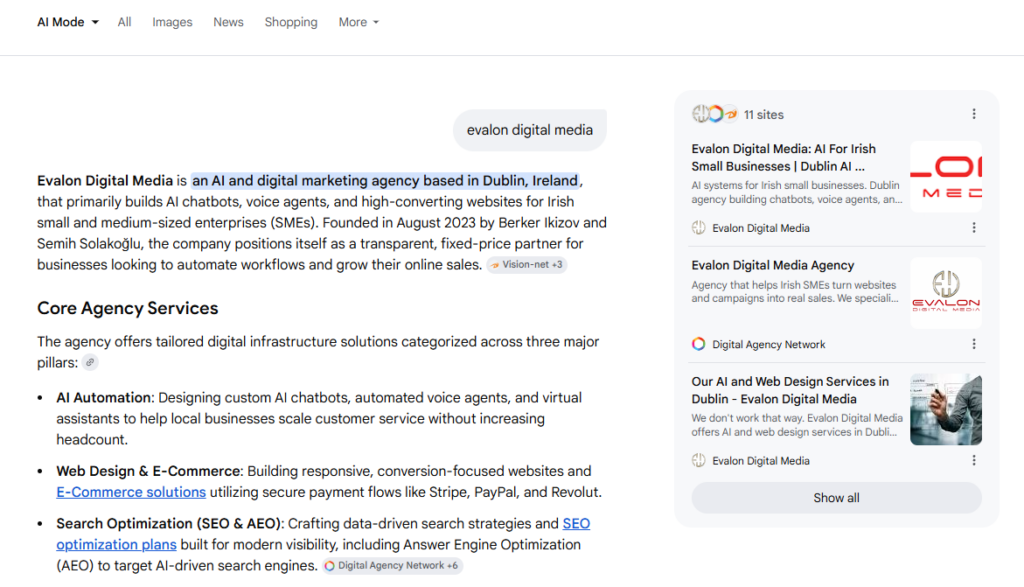
Google AI Overviews. This is the box that appears at the top of Google search results in Ireland for a growing share of queries. It is built from AI summarising the top sources. If your content isn’t structured for it, you can rank on page one and still not appear in the Overview.
Gemini and Microsoft Copilot. Built into Google Workspace and Microsoft 365 respectively. Increasingly used by Irish workers during the working day to research suppliers, tools, services. If your business is one of those suppliers, you need to be in their answers.
Voice assistants (Alexa, Siri) and the search functions inside Instagram, TikTok and LinkedIn are also part of the answer engine landscape, but for most Irish SMEs the four above are where to start.
What does Evalon recommend Irish SMEs do this month?
You do not need a strategy document. You need three actions.
One. Audit your Google Business Profile. A complete, photo-rich, FAQ-loaded Google Business Profile is the single biggest AEO signal a small business has. AI search engines treat your Business Profile as a trust check. If it is half-complete or missing categories, AI engines deprioritise you. Most Irish SMEs have a Business Profile that hasn’t been touched since they set it up. Fix that this week.
Two. Add an FAQ section to your main service pages. Pick the five questions your customers actually ask you and write short, direct answers. Mark them up with FAQPage schema. This is the fastest piece of AEO work you can do. A web developer can add the schema in under an hour, or you can use a free WordPress plugin.
Three. Write one “what is X” page for the thing your business does. Not a blog post. A standalone, well-structured page that answers the question a customer would ask AI before hiring you. If you run a plumbing business, write “What is a power flush and when do you need one?” If you run a salon, write “What is the difference between balayage and highlights?” Make the answer the page. Add an FAQ underneath. That page becomes your AEO asset for years.
None of these cost money. They cost an afternoon of clear thinking.
How long before AEO starts working?
Faster than SEO. Slower than paid ads.
Most Irish businesses doing AEO well start to see visibility in AI answer tools within two to four months of consistent work. The reason it is faster than traditional SEO is that AI engines pull from fresh content actively. A well-structured page can be quoted by ChatGPT within weeks. The reason it is slower than paid ads is that AI citation is not a transaction. You earn it.
The mistake businesses make is treating AEO like a campaign. AEO is a permanent change in how you write and structure your content. The businesses that win are the ones that do small, consistent AEO work every month, not the ones that spend a fortune on a one-off “AI optimisation” project.
Is AEO replacing SEO?
No. AEO is layered on top of SEO. Most AI search engines still use Google rankings as one signal among many. A site that ranks well in Google is more likely to be cited by AI. The two work together, but AEO is the layer most businesses are missing.
Do I need to know how to code to do AEO?
No. The structural work (FAQ schema, structured data) can be added with free WordPress plugins like Rank Math or by a developer in an hour. The writing work, which matters more, is plain English clarity.
Does AEO work for B2B businesses?
Yes. Arguably better than for B2C. Business buyers are heavy users of ChatGPT and Perplexity for supplier research. A well-optimised B2B site often gets cited in research-stage queries that lead to high-intent enquiries.
What’s the difference between AEO, GEO and LLMO?
They mean roughly the same thing. AEO (Answer Engine Optimisation) is the most widely used term. GEO (Generative Engine Optimisation) and LLMO (Large Language Model Optimisation) are alternative names from different agencies. The underlying work is the same.
Can a small business outrank a big competitor with AEO?
Often, yes. AI engines reward clarity and specificity, not domain size. A clear, well-structured page from a small business can be cited ahead of a confusing, badly-structured page from a national brand.
Where should I start if I have one hour this week?
Audit your Google Business Profile. Add missing categories, write a clear business description, upload ten photos with proper captions, and fill out the Q&A section. That single hour will do more for your AI visibility than any other one-hour task.
Want to see if your business is already being cited by AI?
Send your business URL to info@evalondigitalmedia.com. We will run it through ChatGPT, Perplexity and Google AI Overviews to see what is currently being said about you, and where the gaps are. No charge, no sales follow-up. Just the honest picture of where your business stands in the AI answer space.