
The AI Chief of Staff Built for HeartPath
HeartPath runs cardiovascular prevention programmes across Ireland, the UK, and sub-Saharan Africa. They needed an AI chief of staff which understood clinical governance, not a subscription tool they had to adapt to. This is how Evalon built one, from discovery to fully operational system in under 30 days.
The Starting Point
Three active programmes running simultaneously across different countries. No single system connecting email, calendar, research, and programme management. Consequently, information lived in separate places and follow-ups fell through the gaps. Furthermore, clinical research retrieval happened manually, which consumed hours that belonged to programme delivery. When the HeartPath founder completed Evalon’s discovery questionnaire, fifteen specific pain points emerged. As a result, the build had a precise target before a single line of architecture was written.
Our Impact
AI implementation Ireland: One System. Built Around One Operation.
Most AI tools ask the user to adapt. However, this custom AI assistant Dublin build worked in the opposite direction. Evalon ran a discovery session first, mapped every pain point to a specific design rule, and then built an architecture that reflected how the HeartPath founder actually worked. Consequently, AI Virtual Assistant did not need training every morning. Furthermore, the system operated within clinical safety boundaries by design, which was non-negotiable for a healthcare organisation. Here is how each part of the build was approached.
The build
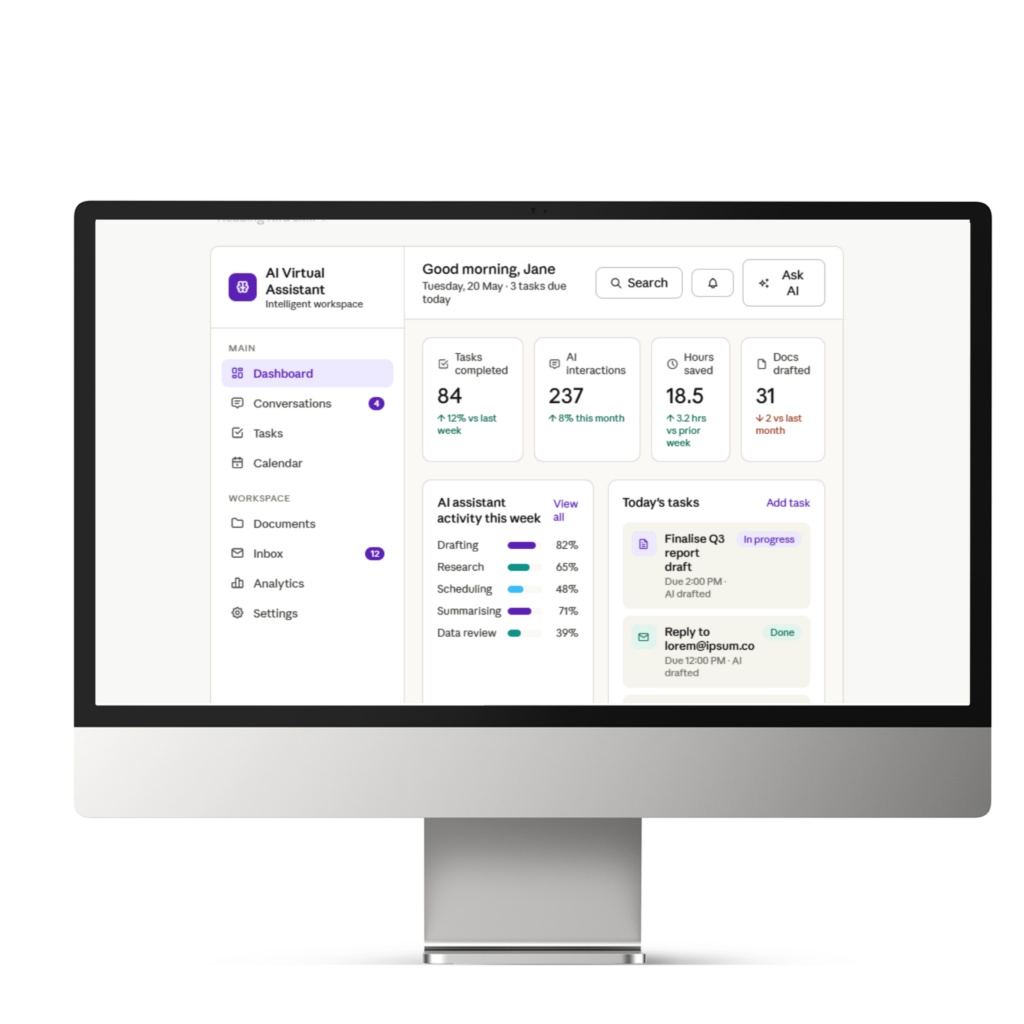
We built this AI Virtual Assistant inside Claude with live connections to five tools: Gmail, Google Calendar, Notion, PubMed, and the ICD-10 clinical coding database. Additionally, we built an Intent Engine into the architecture, which is a pattern library of how the founder communicates, mapped to what she actually needs. As a result, the AI Virtual Assistant interprets abbreviated messages and operational shorthand without requiring full instructions every time.
Then we defined ten enforceable behavioural laws that basically define how the AI Virtual Assistant operates. These behavioural laws prevent the system from exceeding its defined scope on clinical content, and force the accuracy that healthcare AI assistant for nonprofits Ireland requires. Voice mode optimisation was also built in, specifically for the AI Virtual Assistant. Therefore, every response is structured to work as spoken audio, not just as text on a screen.
This custom AI build Dublin approach is Evalon’s standard: discovery first, architecture second, handover with 30 days of tweaks so the organisation runs it independently.
What the build delivered
Would This Help You?
Five custom-designed integration layers, each connected to a tool the founder already used. Moreover, the AI Virtual Assistant retrieves clinical research from PubMed on demand, cross-references ICD-10 codes for programme documentation, and manages calendar and email triage from a single interface. Consequently, the founder stopped switching between five separate applications to complete one task.
Before this build, all operational coordination happened manually. After handover, the AI Virtual Assistant handled scheduling, research retrieval, email triage, and programme documentation autonomously within its defined scope. The founder retained full control through a set of voice commands that trigger specific workflows, and we delivered an instruction manual on how to use the AI Virtual Assistant.
What changed for HeartPath
The AI implementation Ireland outcome here is specific: an organisation running clinical programmes across three continents now has an AI chief of staff Ireland that works to its operational reality, owned completely by HeartPath with no dependency on Evalon for daily use.
Custom AI assistant Dublin: Results at a Glance
Every result below is direct. This is the standard Evalon applies to every custom AI build Dublin project.
| Metric | Before | After |
|---|---|---|
| Operational coordination | Manual, across 5 separate tools | Single AI interface handling all five |
| Clinical research retrieval | Manual PubMed searches | On-demand via calling it’s name in seconds |
| Calendar and email triage | Done by founder | Handled by the AI Virtual Assistant within defined scope |
| Programme documentation | Manual ICD-10 lookup | Automated through live database connection |
| Voice accessibility | None | Full voice mode optimised for mobile use |
| System ownership | No system existed | Fully owned and operated by HeartPath |
Frequently Asked Questions
What is a custom AI assistant Dublin build?
A custom AI assistant Dublin build starts with a discovery session that maps the specific pain points of one organisation. Evalon then architects a system around those pain points, integrates it with the tools the person already uses, and hands it over with 30 days of tweaks. As a result, the system works for that specific operation rather than a generic product the user adapts to.
What tools can a custom AI build Dublin connect to?
The AI Virtual Assistant build for HeartPath connected to Gmail, Google Calendar, Notion, PubMed, and the ICD-10 clinical coding database. Furthermore, Evalon's custom AI build Dublin approach integrates with whatever tools the client already uses, including project management systems, email platforms, research databases, and scheduling tools.
How long does AI implementation Ireland take?
The AI Virtual Assistant build went from discovery session to fully operational system in under 30 days. AI implementation Ireland timelines vary by complexity, but a focused custom AI assistant build for a single user or small team typically runs two to four weeks from brief to handover.
Can an AI assistant for nonprofits Ireland handle clinical or technical content?
Yes, with the right architecture. the AI Virtual Assistant system includes live access to PubMed for medical research retrieval and the ICD-10 database for clinical coding support. Moreover, clinical safety governance rules were built into the system so the AI Virtual Assistant operates within defined boundaries on medical content. An AI assistant for nonprofits Ireland working in healthcare requires this governance layer by design.
What makes an AI chief of staff Ireland different from a standard chatbot?
A standard chatbot answers questions. An AI chief of staff Ireland manages context across multiple ongoing programmes, handles calendar and email triage, retrieves research on demand, and operates through voice commands while the user is away from a desk. Furthermore, the AI Virtual Assistant was built for a founder managing clinical programmes across three continents, which required a fundamentally different architecture than a question-and-answer tool.